Designing the Future of Intelligence: MGXD Students Take on AI-Assisted Reporting
Some design problems come with real stakes. For one MGXD studio, that meant working at the edge of AI, intelligence, and human judgment.
This article was written by Professor Helen Armstrong and originally published at NC State College of Design.
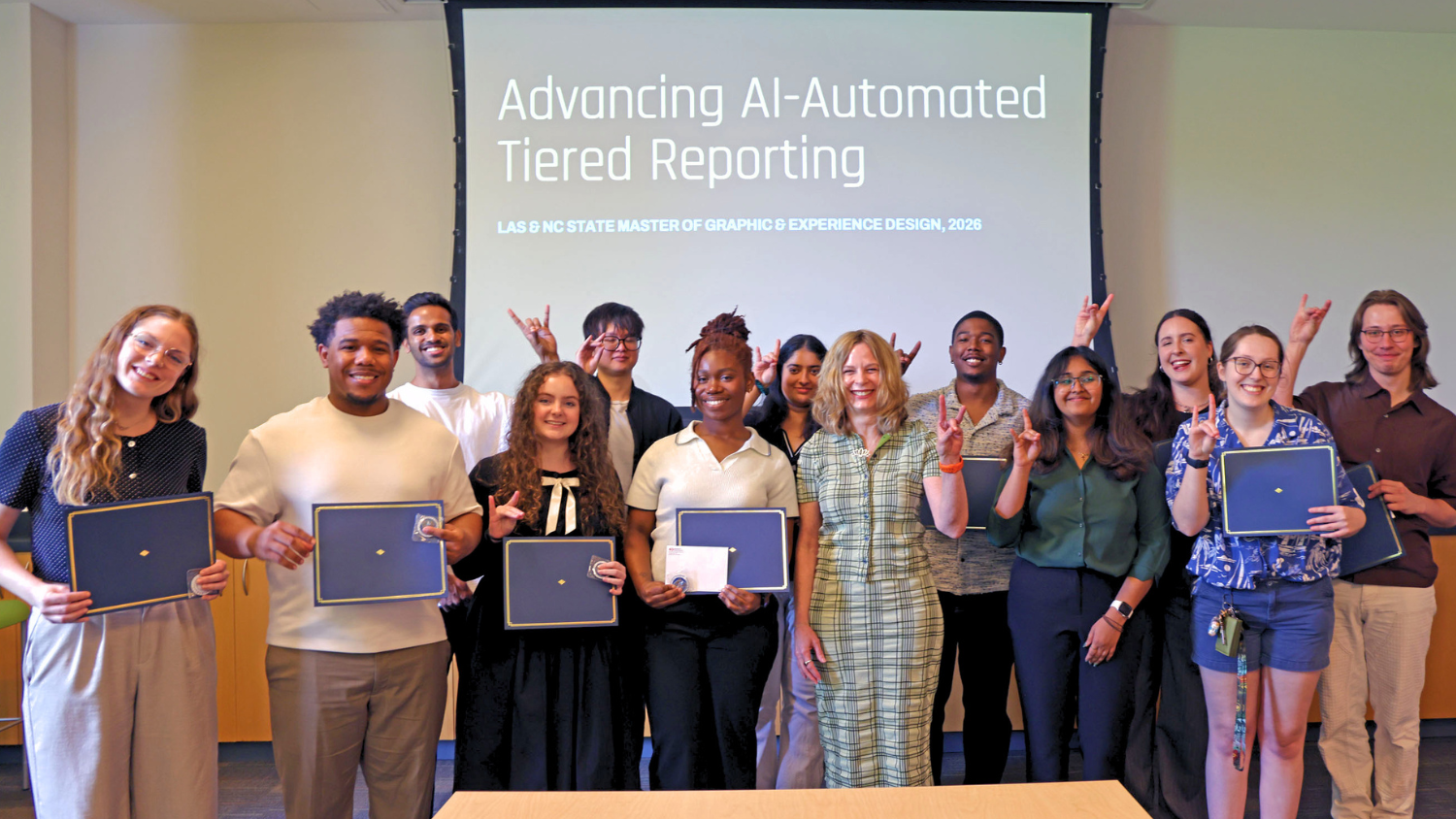
Students in NC State’s Master of Graphic & Experience Design (MGXD) program recently collaborated with the NC State Laboratory for Analytic Sciences (LAS) on a genuinely novel design challenge: how do you build an interface that helps intelligence analysts work with AI to move sensitive information safely and efficiently through a tiered reporting system? Tiered reporting — the structured process of tailoring intelligence for different audiences based on their security clearance, expertise, and need-to-know — is critical work. It’s also painstaking, high-stakes, and ripe for thoughtful design innovation.
Led by Professor Helen Armstrong, student teams began by going deep on the existing workflow, mapping pain points and friction across the reporting process. From there, they developed original UX/UI concepts that integrate AI not as a replacement for human judgment, but as a collaborative partner — one that helps analysts sanitize content, calibrate detail levels, and deliver the right information to the right people without compromising security.
The Design Question
The central design question driving the project: How might an interface automate the tiered reporting process so that analysts can more efficiently and knowledgeably team with AI?
That question opened up three rich areas of exploration:
Oversight — How should an interface surface AI recommendations and flag data modifications so analysts always stay informed and in control as content moves across classification tiers?
Agency — How do you design for human involvement in a more automated system, keeping analysts active, deliberative participants rather than passive observers?
Trust Calibration — How can an interface honestly communicate what AI can and can’t do — especially for analysts at different experience levels — so that trust in the system is earned, accurate, and appropriately bounded?
Student Prototypes
ARC
Designers: Willow Ahrens, Clara Matthews, William Whitley, Graphic & Experience Design, © NC State University, All Rights Reserved
Merlin
Designers: Mia Biehler, Tushita Kaul, Sean Ran, Graphic & Experience Design, © NC State University, All Rights Reserved
LogIQ
Designers: Donté Coleman, Amaya Hush, Katie Kirke, Graphic & Experience Design, © NC State University, All Rights Reserved
Infinity Canvas
Designers: Colton Hendrix, Diya Franklin, Swatik Salinera Parthasarathy, Graphic & Experience Design, © NC State University, All Rights Reserved
The Future of Design
The results were a range of future-facing interface concepts that push the boundaries of what human-AI collaboration can look like in high-stakes, information-sensitive environments. The interfaces don’t exist yet. The thinking behind them does — and that’s where every important design project begins.
- Categories: